


 |
IBM’s latest mainframe, the z10 Enterprise Class (EC) doesn’t compare well to the BMW Z10 when it comes to acceleration, cornering or cup holders. But the IBM machine stands out in terms of processing power, security and availability. Further, the System z10 is designed to reduce energy usage and save floor space when engaged in server consolidation. Specialty processing engines expand the use of the mainframe for a broader set of applications
When it comes to acceleration and cornering, the BMW Z10 gets top marks. But if you’re after reduced energy consumption and floor space in a mainframe, the IBM z10 is the way to go.
“The new z10 was a $1.5 billion investment, which took five years to develop with a global team of more than 5,000 technical professionals,” said Joe Doria, director of System z global marketing at IBM (Armonk, N.Y.). “The z10 with z/VM and Linux can result in a total cost savings of 74 percent, energy savings of 81 percent, people savings of 93 percent, software savings of 81 percent, and it reduces the number of engines/cores by 91 percent as compared to x86-based servers with VMware.”
The System z10 EC server has supplanted the IBM System z9 EC (announced in July 2005) as the highest-end mainframe server in IBM’s arsenal. According to Doria, the z10 is 50 percent faster than its predecessor and offers 70 percent more capacity.
Additionally, the new IBM z10 has chip technology that has a 2.6X higher frequency, three-fold more memory than the z9, and a 70 percent larger maximum server configuration than its predecessor. That’s a quite hefty collection of “incremental gains” for a platform analysts pronounced dead more than a decade ago.
|
|
|
Unsure About an Acronym or Term? Search the ServerWatch Glossary |

What isn’t commonly realized is just how much juice a mainframe can produce. While x86 chips get all the ink for their GHz and multiple cores, the mainframe has had perhaps even more impressive performance gains in recent years.
“Over the last decade, the processor speed from the mainframe has gone from 300 MHz to now 4.4 GHz with the new z10,” said Doria. “With the z10, you get over 30,000 million instructions per second (MIPS) at the top end, compared with nearly 18,000 MIPS on the previous z9 Enterprise Class.”
IBM describes a z10 central processor (CP) as having 991 million transistors. This 4-core processor has 3MB of L2 cache per core. A separate, dedicated “service” processor adds 24MB of L3 cache, sharable among all the processor cores. The highest-end z10 processors use five quad-core die packages and two service cores; that’s 20 cores at 4.4 GHz, 3MB of L1.5 cache per processor Unit (core) and 48 MB of shared L2 cache on the book.
Five z10 models are available: the E12, E26, E40, E56 and E64. The number simply signifies the maximum number of processors.
“Essentially, the five models represent the capacity increments: the E12 has up to 12 processors and the E64 has up to 64 processors,” said Doria. “Processor units can be characterized by the customer between CPs (normal processors for traditional workloads), IFLs (Linux processors), zIIPs (DB2 Engines) and zAAPS (Java engines).
In addition to scaling upward in terms of processors (and memory too, of course), the mainframe scales in units that IBM calls “books.” Books represent the units of infrastructure that can be independently upgraded or maintained for extremely high availability. An E12 is a 1-book infrastructure, an E26 is a 2-book infrastructure, an E40 is a 3-book, and both the E56 and E64 are 4-book models.
“This gives extreme flexibility in scalability and availability for new and traditional workloads,” said Doria. “In addition, the CPs can be designated for On/Off Capacity on Demand to take care of peak loads, or Capacity Backup which allows you to back up another mainframe.”
Growing Market
Far from being in its death throes, the z10 represents the cutting edge of what has become a growing mainframe marketplace. According to IDC’s high-end (i.e., $250,000 and up) server quarterly tracker, since 2000, IBM System z’s market share has doubled — growing from 17 percent to 34 percent. Doria reported that IBM has recorded growth in its mainframe revenues in five of the past seven quarters.
Further, not just long-term U.S. and European customers are continuing to upgrade their mainframe infrastructures. Emerging markets such as Brazil, Russia, China and India showed 18 percent growth in 2006 compared to the previous year. And on the development front, 600 new applications were introduced for the IBM mainframe in 2007 — bringing the total to more than 4,000 for the System z platform.
Doria admits, however, that there is a predominance of repeat business.
“Traditionally, if we have customers who have been z9 or even z990 customers, they tend to upgrade to the latest and greatest IBM mainframe systems,” he said. “Mainframes have some of the lowest total cost of ownership and lowest business transaction costs compared to other platforms; and along with their leading security and resiliency, more customers are looking to consolidate open workloads onto z10 ECs because they can run mixed workloads and utilize the z10 EC server up to 100 percent.”
He cites as System z customers: the top 50 worldwide banks, 22 of the top 25 U.S. retailers, and 6 of the top 10 global insurance providers. Some of them are moving to the new z10 EC.
“Enterprise customers have continued to embrace the IBM mainframe product line as the backbone of their enterprise, and have significantly expanded its use largely via new workloads on the IFL (Linux), zAAP (Java), and now zIPP (database) specialty engines,” said Mike Kahn, managing director of The Clipper Group. “The largest mainframe customers will be pleased with the expansion of the capacities and capabilities of the Enterprise Class models.”
| Name | z10 EC | 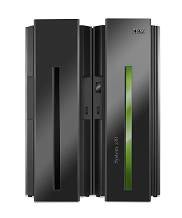 |
| Vendor | IBM | |
| Platform | Mainframe | |
| Dimensions | 2.83 sq meters (30.44 sq ft) | |
| Processor Details | Processors available are Central Processors (CPs, for traditional workloads), IFLs (Linux processors), zIIPs (DB2 Engines) and zAAPS (Java Engines) | |
| Hard Drives | Connects externally to disk, and has 1,024 channels to connect to disk or tape | |
| Operating Systems | z/OS, z/OS.e, z/VSE, TPF, Linux on System z and the z/VM hypervisor | |
| Configuration Options | Models available are E12 (up to 12 processors), E26 (up to 26 processors), E40 (up to 40 processors), E56 (up to 56 processors) and E64 (up to 64 processors); Pricing starts at around $1 million | |
| Availability | Now available | |
| Warranty | One year | |